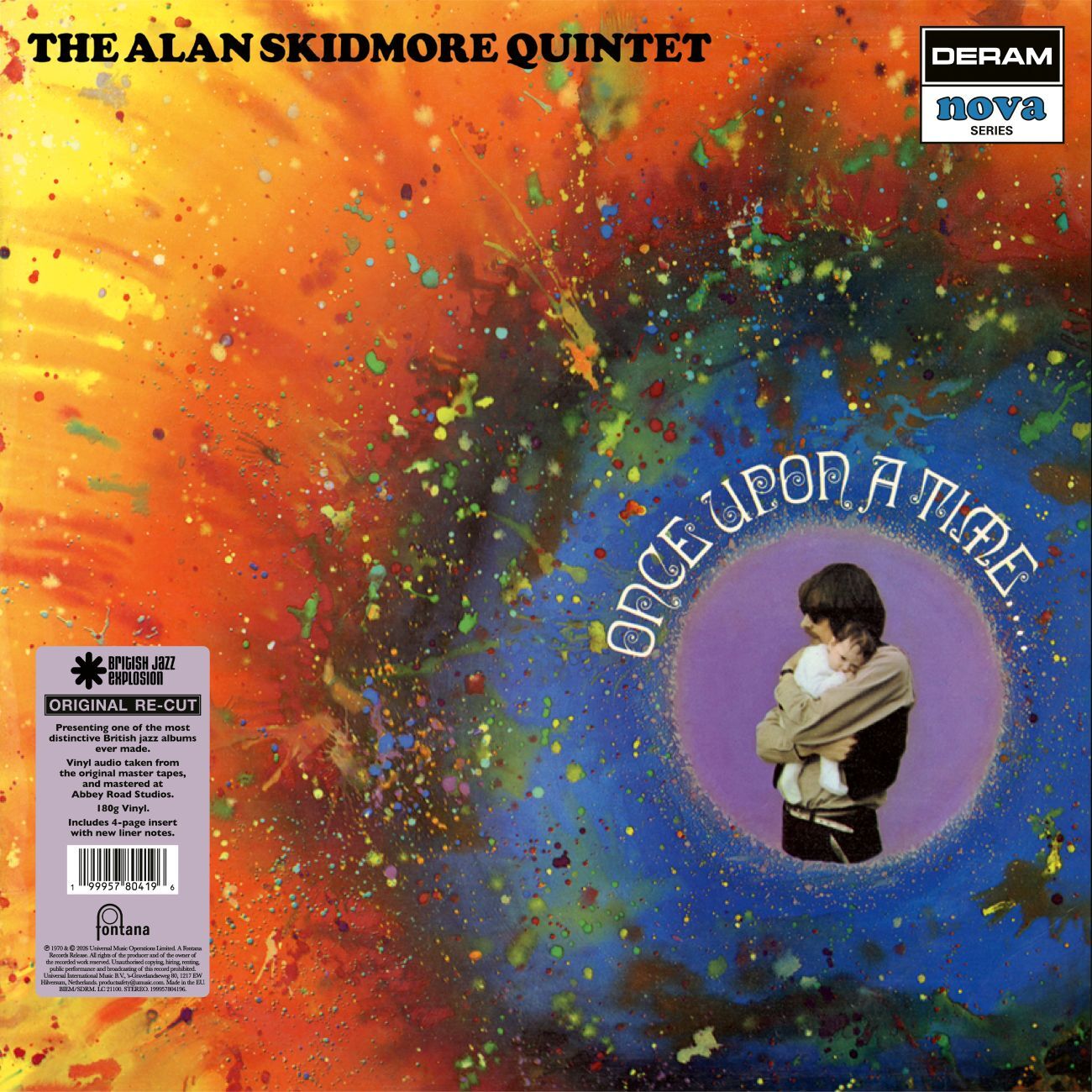
The Alan Skidmore Quintet - Once Upon a Time - 180g Vinyl LP
British Jazz Explosion
2026
It’s unusual to want to write a rave review of sleeve-notes, but especially so if the notes are for an album you haven’t even played yet. In the case of this fabulous vinyl reissue of the great tenor saxophonist Alan Skidmore‘s debut album, first released in 1970, the notes are so good, and so essential to an understanding of what is by any standards a key recording in the history of English jazz, that they really do enhance the experience of listening. But just to whet your appetite for what is to follow, here are the names of the band: Kenny Wheeler, John Taylor, Harry Miller, Tony Oxley.
In truth there are actually two sets of notes: the serviceable original ones on the back of the facsimile sleeve, written at the time by the BBC jazz producer Roger Eames, and – more pertinently – writer Tony Higgins’ incredibly detailed, diligently researched and appropriately lengthy essay-type piece which occupies three of the four pages of the reissued LP’s printed insert. These cover a whole host of fascinating material, from the provenance of the photo on the sleeve of Alan holding his new baby Alice, taken by his wife Kay, to his reluctant apprenticeship into learning his instrument supervised by his well-known saxophonist father, Jimmy Skidmore; to the transcendent moment of seeing his future idol John Coltrane, whose quintet with Eric Dolphy was supporting Dizzy Gillespie, at a concert at the Granada Theatre in Walthamstow on Friday 17 November 1961. “He just played My Favourite Things for a whole set – 50-55 minutes”, Skidmore remembers for Higgins. “And I remember walking out of there that day going, “Wow, he was good – that saxophone player, crikey.” And that was my introduction to John Coltrane.”
The notes go on to cover Skidmore’s subsequent dedication to Trane and modal jazz, his Sixties sessions with John Mayall and Alexis Korner, and long hours matching moonlighting at the Talk of the Town nightclub with daytime sessions at the BBC and avant-garde after hours experiments at Ronnie’s Old Place; plus the Montreux Jazz Festival and much more. Higgins also gets great info from original producer Peter Eden, who recalls initial difficulties at the album’s sessions in the Decca Studio, when the brown-coated engineers couldn’t get Skidmore’s sax to sound how he wanted.
It’s evident from listening to the album, newly remastered from the analogue tapes (by Alex Gordon at Abbey Road Studios), that despite changing engineers and eventually getting a sound Skidmore felt he could work with, it wasn’t comparable to Coltrane, or the swagger of Dexter Gordon, his other great role model. What repeated listening to Once Upon A Time makes clear- and just knowing the names of the band-members and composers gets you halfway there, anyway – is that this music isn’t really about refried American modes: it’s English, and European, modern jazz at a historical point where the modal is beginning to meet free improvisation.
It is also often very lyrical and interiorised rather than all outward-facing and extroverted, although the players can certainly swing hard when they want. The album’s opening title track, written by John Surman, demonstrates this perfectly, with John Taylor’s delicate piano introduction setting the scene for a beautifully poised theme shared by Skid and Wheeler. Taylor does seem to sneak in a Bill Evans ‘Kind of Blue’ quote later on, too. Majaera, by Oxley, which follows, sounds almost totally improvised, while Taylor’s The Yolk sets up a very elastic sense of metre for Skidmore to solo on.
Side Two begins with a very strong tune written by John Warren, Old San Juan, that sounds like a curiously Anglicised Horace Silver. Skidmore’s Free For Al, that follows, is as the title suggests, a bit of a blowing vehicle, and a feature for Oxley’s drums. The album ends with another Surman composition, Image, a free-ish freak out with Skidmore sounding as close to late Coltrane as he does anywhere on the LP, with Taylor supplying Tyneresque rolling breakers for him to soar over. And after that, following Skidmore’s “crikey” reaction to Coltrane, you can only say “blimey”, or maybe “bloomin ‘ell”.
The last laugh comes from Tony Higgins’ superb sleevenotes, where producer Peter Eden recalls trying to enthuse Decca’s reps with the potential for Once Upon A Time to be attractive to progressive or underground rock fans, like Ten Years After or other acts in the Deram Nova series. Great as the album is, that was never going to happen. But the reissue’s facsimile sleeve does feature a printed version of the cut-out small circle on the rear of the cover that I remember from my copy of a terrible Ten Years After LP. If the circle showed red, the record was mono. Blue was for stereo.
by Phil Johnson
18 October 2026
https://ukjazznews.com/the-alan-skidmore-quintet-once-upon-a-time/
(199957804196)
| SKU | 199957804196 |
| Barcode # | 199957804196 |
| Brand | Deram Nova Series / Fontana |
Be The First To Review This Product!
Help other Birdland Records users shop smarter by writing reviews for products you have purchased.