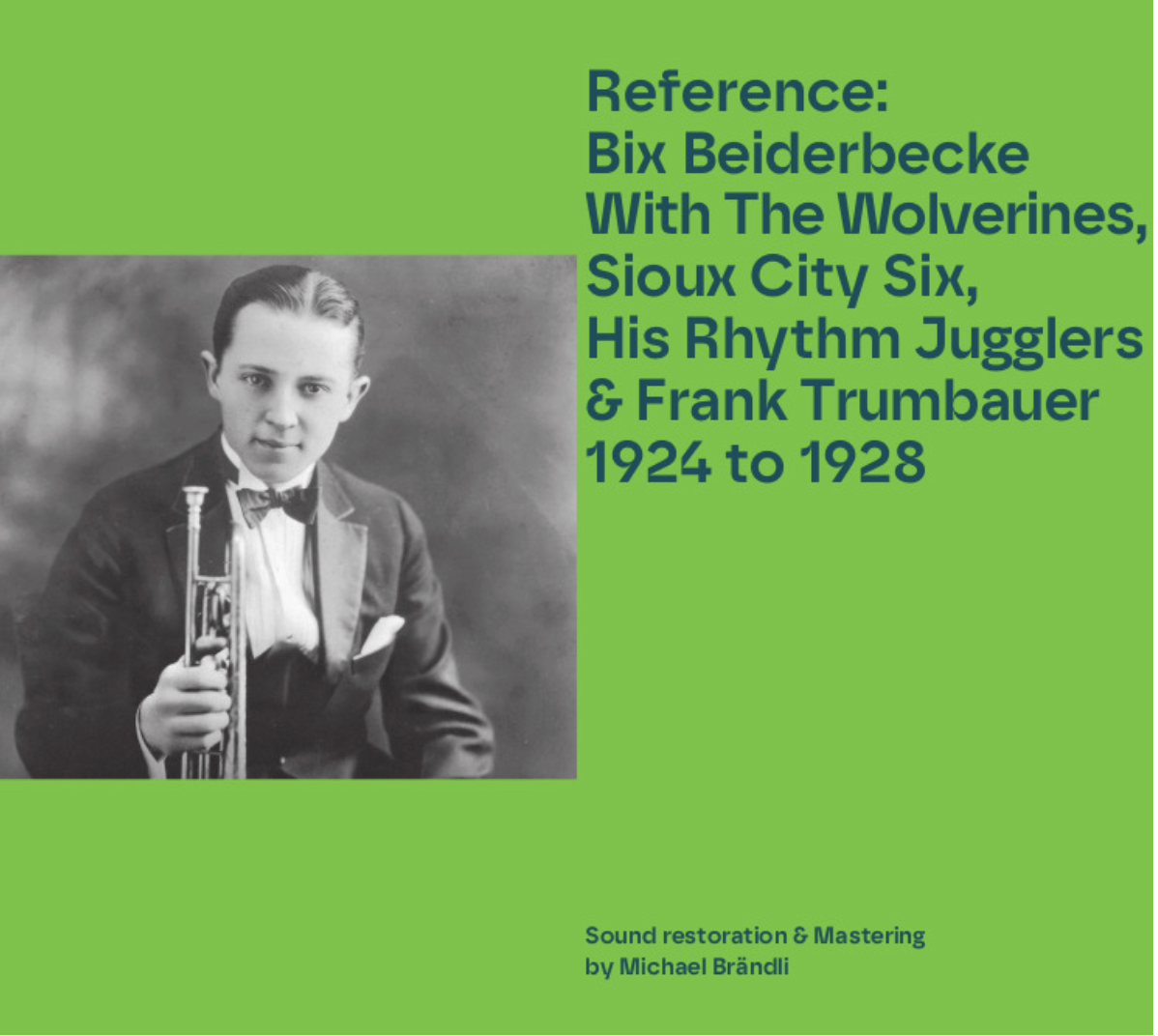
Bix Beiderbecke - With The Wolverines, Sioux City Six, His Rhythm Jugglers & Frank Trumbauer 1924 to 1928
2026 CD release - 2 CD set
2026
Books have been written, recordings analyzed, colleagues questioned, and nevertheless Bix Beiderbecke remains as much an enigma today, ninety-five years after his death, as he was to friends and fellow musicians during his all-too-brief, personally and professionally erratic odyssey through the 1920s. The body of work he left behind both reveals and conceals crucial aspects of his creative reality and unfulfilled potential, while innovating a subtle, eloquent manner of expression that would suggest future alternative options of jazz composition and improvisation. These forty-five pieces constitute the best of his small group performances, and illustrate how the music evolved over several distinct paths throughout its early years.
"It’s important to note that, at home as a child in Davenport, Iowa, the piano was his first instrument and, according to all accounts throughout his life, would remain the medium for his furthest, if seldom shared, harmonic and formal experimentation. Of the three examples of his piano playing here, two, the trios “For No Reason At All in C” and “Wringin’ and Twistin’” show he was more than competent at outlining the tune’s chordal structure and sustaining the rhythmic undercurrent (and, ironically, each concludes with a cornet flourish). The third is his visionary hybrid of Impressionism and ragtime, “In a Mist” (although his interest in Impressionist composers Ravel and Debussy has been frequently documented, there are hints he was also familiar with the rhythmic twists and harmonic tang of Stravinsky’s “Rag-time” and “Piano-Rag-Music,” composed in 1918 and 1919, though he apparently never ventured into the “modernist” perspective – Schoenberg, Berg, or Bartok – of the period.)
Beiderbecke was introduced to the cornet, and jazz, as a teenager, via the Original Dixieland Jazz Band’s initial recordings. He became proficient on the instrument quickly, and used it as a means of escape from his environment through out of town gigs; eventually, for reasons not clearly documented, he was exiled by his family to Lake Forest Academy – fortunately the proximity to Chicago gave him access to a broader range of working musicians, including Louis Armstrong and, more frequently, the emulative but capable New Orleans Rhythm Kings, in residence at the city’s Friar’s Inn. Perhaps not surprisingly, the latter proved moreinfluential on the young cornettist than the incomparable Armstrong or his then-boss, the savvy King Oliver.
As the earlier tracks with the Wolverines show, these youthful novices hadn’t the technique nor expertise to match the inventive majesty of the transplanted New Orleanians, black or white, and so found it necessary to devise an alternative strategy to seduce the rigors and freedoms of the new style. Without the firm foundation of the blues, they relied on arrangements, softened and smoothed over the harshest accents, emphasizing moderate tempos and a congenial, flowing ensemble feel that was suitably danceable. Much the same could be said of the groups of 1927 and ’28, with personnel of a higher level of musicianship, largely drawn from the Jean Goldkette and Paul Whiteman orchestras, where Bix had found fugitive employment. Among these professionals, motivated by the record companies, popularity meant financial success, and so novelty (with more adventurous arrangements) and danceability often took priority over innovation and self expression. And this is where Beiderbecke’s genius dominated his surroundings, and inspired a course for the future.
Something in his psyche was drawn to the Apollonian, rather than Dionysian, sensibility; his attention to classical music reflected an aesthetic awareness to organization of material in larger forms, carried over into the disciplined crafting of his cornet solos – a unique voice based upon economy of gesture, coherent connected phrasing, uncommonly graceful lyricism, and a purity and clarity of tonal resources. Working from a different premise as his bandmates, there is a sophisticated, polished, poised quality to his statements that transcends merely finding a convenient niche within the conventions of the day, and which characterizes the composer’s art – formal rather than instinctive, rational rather than ecstatic – curiously close, it seems to me, in conceptual attitude to another, albeit distant artist of the time, Piet Mondrian, whose rejection of conventional imagery and design required a new appreciation of logic and proportion, and who, only perhaps coincidently, appreciated the rhythms of jazz (specifically stride and boogie-woogie piano, derived from ragtime) above any other music.
Alas, dying at the age of 28 – on the cusp of the Swing Era and a new set of harmonic, rhythmic, and formal advances in the music – and not having the opportunity for a much fuller career as did Armstrong, or Ellington, deprives us of experiencing how his art would have adapted, developed, or possibly shifted direction into full-blown composition. As a result, he is, to our loss, permanently a figure of the 1920s – and yet this music survives, and its distinctive, creative, life-affirming qualities make it forever valuable and worth rediscovering."
- Art Lange
(7649988716843)
| SKU | 7649988716843 |
| Barcode # | 7649988716843 |
| Brand | AlAy Records |
Be The First To Review This Product!
Help other Birdland Records users shop smarter by writing reviews for products you have purchased.